
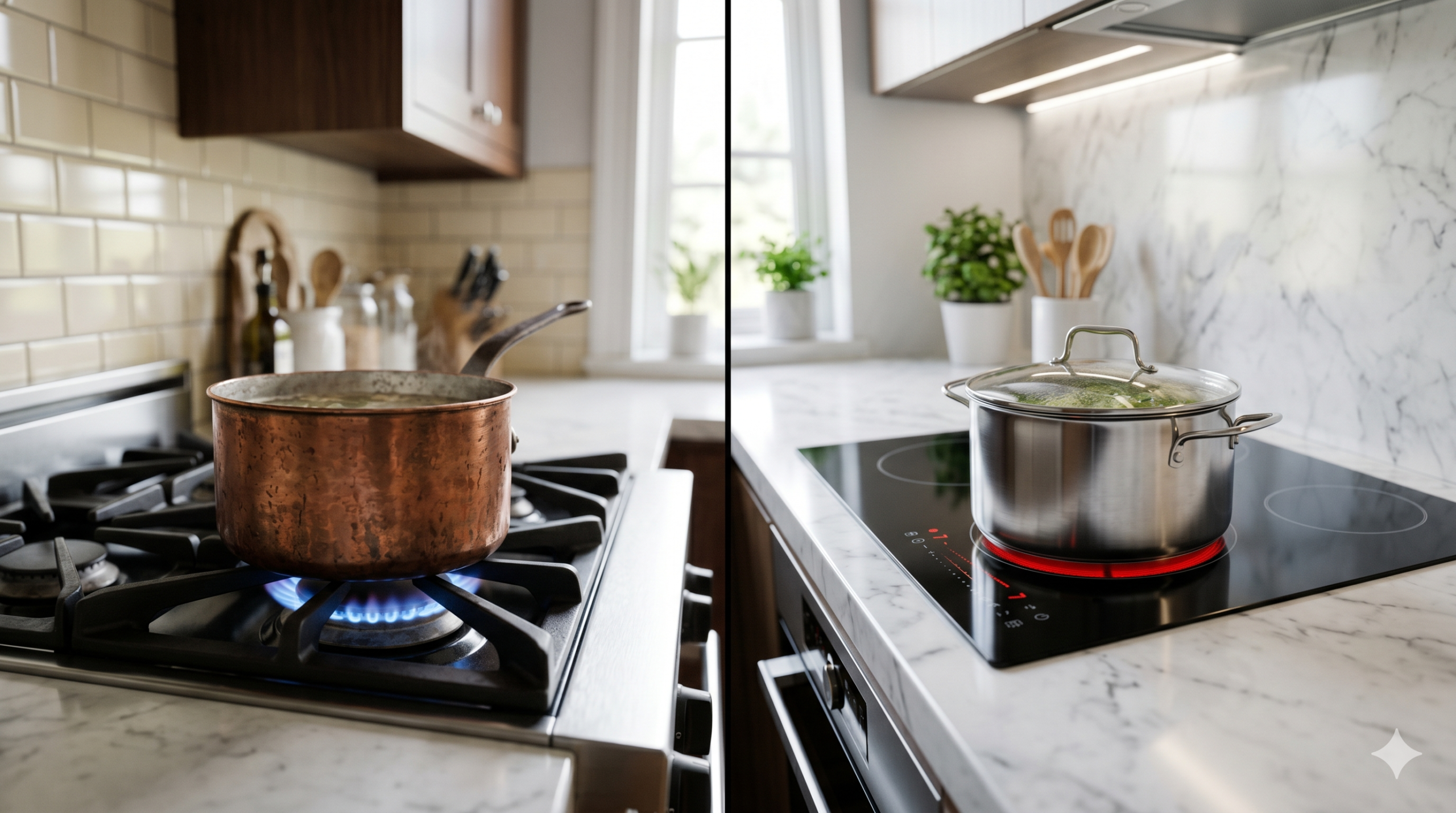
Gas Cooker vs Induction Cooker: Which Is Better for Home Cooking in 2026?
Deciding between a gas and induction cooker in 2026 depends on your priorities, but induction is the superior choice for most modern homes. With 85-95% energy efficiency, significant health benefits from reduced NO2 exposure, and government rebates up to $840, induction outpaces gas in performance, safety, and long-term value.
Quick Summary: Key Takeaways
- Efficiency: Induction is roughly 85-95% efficient, whereas gas wastes 60-70% of its energy heating the surrounding air.
- Health: Switching to induction eliminates major sources of indoor NO2 exposure, which is linked to respiratory issues.
- Safety: Induction uses magnetic fields rather than open flames, featuring pan detection and surfaces that stay cool to the touch.
- Cost: While gas prices remain volatile due to the Strait of Hormuz LPG crisis, induction users can access rebates up to $840 (US) or $3,000 (California).
Why are people switching from gas to induction stoves in 2026?
The massive shift toward induction cooking in 2026 is driven by a combination of economic necessity and health awareness. As geopolitical tensions contribute to the Strait of Hormuz LPG crisis, the induction vs gas stove running cost has tilted heavily in favor of electric.
Furthermore, the global push for electrification has changed the regulatory landscape. Homeowners are looking to future-proof their kitchens against potential gas bans and rising fossil fuel surcharges.
Beyond the bills, the move is personal. Many families are making the switch to improve indoor air quality after recent data highlighted the hidden dangers of combustion-based cooking.
Is induction cooker more energy efficient than gas in 2026?
Yes, the efficiency gap is staggering. Recent 2026 testing shows that induction cooktops operate at 85-95% efficiency, while gas stoves hover between 30-40%.
This means that when you cook with gas, more than half of the energy you pay for is literally vanishing into thin air as wasted heat. This wasted energy not only inflates your utility bills but also makes your kitchen uncomfortably hot during summer months.
In contrast, induction uses electromagnetism to heat the cookware directly. This “direct-to-pan” heat transfer makes induction up to three times more energy efficient than traditional gas burners.
Is induction hob vs gas hob indoor air quality a real concern?
Health has become a primary factor in the gas cooker vs induction cooker for home cooking 2026 debate. A landmark 2025 Stanford-linked study revealed that gas stoves expose residents to NO2 levels that often exceed outdoor safety standards.
The American Public Health Association reports that over 50% of homes using gas stoves in winter experience dangerous nitrogen dioxide spikes. For those in small apartments, this exposure is even more concentrated, making the switch to induction a vital health upgrade.
By removing the flame, you remove the combustion byproducts. Switching to induction is one of the most effective ways to meet WHO long-term NO2 guidelines within your own home.
Is induction cooking safer than gas?
Safety is where induction technology truly shines in 2026. Because there is no open flame, the risk of accidental fires or gas leaks is virtually eliminated.
Modern induction hobs are equipped with pan detection technology; the surface will not heat up unless a compatible magnetic pan is present. Most 2026 models also include child lock functions and auto-shutoff timers as standard baseline features.
For households with children or elderly members, the “cool-to-the-touch” glass surface prevents accidental burns. Even after a pot of water reaches a boil, the surrounding cooktop remains safe to touch within seconds.
Which is cheaper to run, gas or induction cooking?
While the gas vs induction stove installation cost can be higher due to potential 240V outlet upgrades, the running costs tell a different story. Rising LPG prices and new carbon taxes on residential gas have made electricity the more stable financial bet.
In the U.S., the Inflation Reduction Act has been a game-changer. Low-to-moderate income households can access an appliance rebate of up to $840 for a new induction range.
For those in the West Coast, the California Energy Smart Homes bonus offers a massive $3,000 rebate for homeowners who fully electrify. These incentives often cover the entire price difference between a gas and induction unit.
Gas vs induction: Which is better for Indian/Asian wok cooking?
The “wok hei” or “breath of the wok” has traditionally been the last stronghold for gas lovers. However, 2026 technology has caught up with specialized concave induction zones designed specifically for round-bottom woks.
High-end induction hobs now allow for precise temperature control, letting you set a specific degree for delicate tasks like melting chocolate or tempering spices. This level of accuracy is nearly impossible to achieve with an analog gas flame.
If you are a serious home chef, the instant response of induction—which changes temperature faster than gas—provides a level of culinary control that was once only available in professional kitchens.
Can I use my existing pots and pans on an induction cooktop?
The most common hurdle for switching is cookware compatibility. Induction requires magnetic materials like cast iron or magnetic stainless steel.
If a magnet sticks to the bottom of your pan, it will work on an induction stove. While you may need to retire your old copper or aluminum pots, the performance boost of induction-compatible cookware is usually worth the investment.
Next Steps: Elevate Your High-Efficiency Kitchen
Once you’ve upgraded to a precision induction cooktop, the next step is mastering the art of healthy, fast-paced cooking. Modern stoves deserve modern recipes.
To get the most out of your new kitchen setup, we recommend pairing your tech with a high-performance nutrition plan. The Fat-Burning Kitchen or a professional Metabolic Cooking system can help you leverage that precise temperature control to create world-class, healthy meals in half the time.
FAQ: Common Questions in 2026
Does an induction stove work during power cuts?
Standard induction stoves require electricity to function. However, the latest 2026 “Battery-Ready” models, specifically those eligible for the California Energy Smart Homes bonus, can include built-in battery storage to keep you cooking even when the grid goes down.
Do induction cooktops need special wiring?
Most full-sized induction ranges require a dedicated 240V circuit. If you are replacing an old electric coil stove, the wiring is likely already there. If you are switching from gas, you should factor in the cost of an electrician to install the appropriate outlet.
Is induction better for the environment?
Absolutely. Beyond the 90% efficiency, induction is a cornerstone of the decarbonization movement. By powering your stove with a green energy provider, your cooking becomes carbon-neutral—something impossible with a gas flame.