How to Get a Better Hotel Room Without Paying Extra: 9 Tips That Actually Work
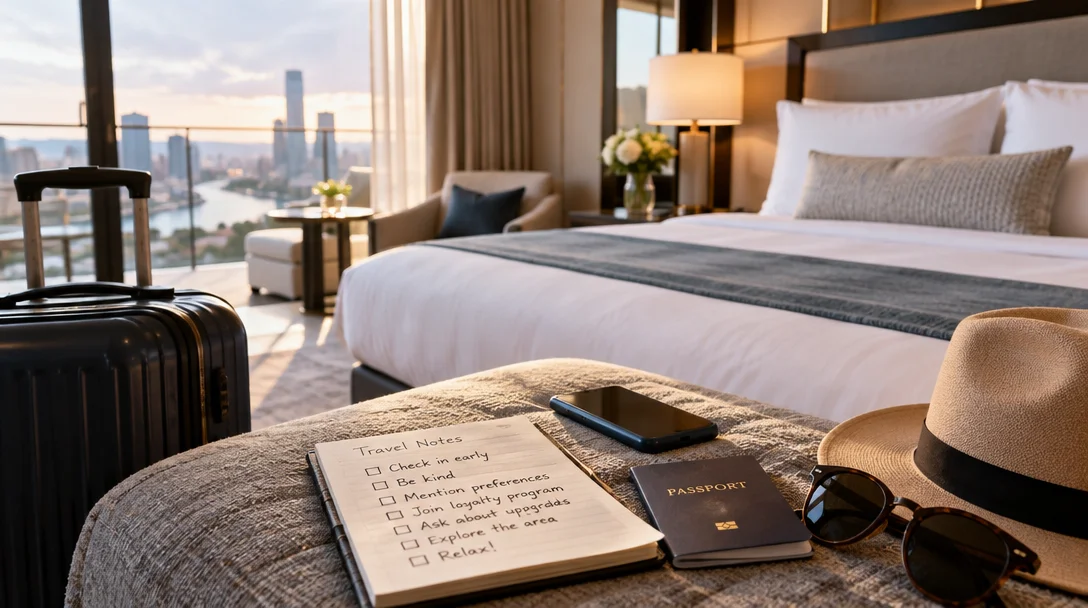
Ask at check-in for a corner room or a high floor away from the elevator, book direct and join the loyalty program before arrival, and travel midweek or off-season when the hotel has empty rooms to be generous with.
Most people assume the room you get is locked in the moment you click “book.” It isn’t. Hotels usually assign specific rooms at check-in, and there’s a lot of room (sorry) for a polite request to change the outcome. Here’s how to reliably end up with a better room without paying for an upgrade.
Quick Answer
Ask politely at check-in for a corner room or a higher floor away from the elevator, book directly with the hotel or through a program that includes upgrade perks, and join the loyalty program before you arrive. Traveling midweek or off-season helps too, since upgrades are mostly a game of empty rooms.
1. Ask for a corner room
It’s the closest thing to a free upgrade that exists. Because of how buildings are laid out, corner rooms are often slightly larger than standard rooms, and they only share one wall with a neighbor, which makes them noticeably quieter. Hotels almost never sell “corner room” as its own category, so if one is free when you check in, the front desk can often just give it to you. Two seconds of asking, months of better sleep.
2. Go higher, and away from the machines
If quiet matters to you, aim for a higher floor at the end of the hallway. You get less street noise and fewer people trudging past your door at 1 a.m. Rooms near elevators, stairwells, ice machines, and utility closets tend to be smaller and louder, so ask to be away from all of those. Near the lobby or the rooftop bar? Also worth avoiding if sleep is the priority.
3. Tell the hotel what you want before you arrive
Add a note to your reservation or reply to the confirmation email: high floor, quiet room, away from the elevator, or a view if the hotel has one. The operations team reviews arrivals in advance, and a known preference is much easier to accommodate than a surprise at the desk. If you’re celebrating something, say that too. Hotels like milestones, and mentioning it when you book works far better than springing it at check-in.
4. Book direct when upgrades matter
Major chains like Marriott, Hilton, and Hyatt mostly hand out upgrades to guests who booked through their own website or app, because those bookings cost the hotel less and come with guest history attached. A third-party bargain rate can still be the cheaper play for a one-night stopover, but if you care about the room, book direct and log into your loyalty account while doing it.
5. Join the loyalty program, even for one stay
It costs nothing and takes two minutes. Even the lowest elite tier in some programs gets you a “preferred room,” which typically means a higher floor or a better view. If you stay with the same brand a few times, the odds improve fast. Returning guests get upgraded far more often than first-timers, and the desk can see your history either way.
6. Time your trip around empty rooms
Upgrades are mostly inventory math. When occupancy is low, the front desk has freedom to be generous; when the hotel is packed, nobody is getting moved. Midweek stays and off-season travel give you the best odds. Sundays and Tuesdays are typically the cheapest check-in days, while Fridays are the priciest, so a Sunday-to-Wednesday trip stacks the deck in your favor twice: a lower rate and emptier floors.
7. Check in at a smart time
Rooms generally turn over between 2 and 3 p.m., and 5 to 7 p.m. is check-in chaos. Arriving around 4 or 4:30 p.m. often works well: the rush hasn’t hit, and the desk already knows whether they’ll need to shuffle rooms. Arriving very late can backfire, since the leftover rooms are, by then, the leftover rooms.
8. Be the guest the desk wants to help
Front desk staff decide upgrades in seconds, and likeability beats confidence every time. Skip the demands and the twenty-dollar-bill theatrics. A warm, specific, open-ended ask works better: “Any chance of a quiet room away from the elevator, or a corner room if one’s available?” If something does go wrong with your room during the stay, mention it politely. Hotels would rather fix a problem, sometimes with a better room, than lose you to a bad review.
9. Watch for the paid upgrade that’s actually cheap
In the final days before check-in, hotels often email targeted upgrade offers, sometimes at a steep discount, and you can also book upgrades with loyalty points for little or no cash. At the desk, unsold premium rooms are frequently offered at a fraction of their listed price. It’s not free, but paying $30 for a suite that lists at $120 more is close enough.
What doesn’t work
Some classic tricks are more myth than method. Bluffing that you’re a VIP gets you exactly nowhere, since the desk can see your actual history. Hinting at a TripAdvisor review works only in the sense that being pleasant works. And the old advice to book a cheap room and hope for the best ignores the one thing that consistently matters: hotels upgrade the guests they know and like, not the ones who paid the least and asked for nothing.
Bottom line
A better room usually comes down to three moves: book in a way the hotel rewards, tell them what you want early, and ask nicely at the desk. Do all three and you’ll outperform most travelers before you’ve even unpacked.