How to Plan Your First International Trip: A Step-by-Step Guide

Plan your first international trip by confirming passport and entry rules first, setting a realistic total budget, booking flights and your first hotel in that order, then sorting out money, phone data, and an arrival-day plan.
Quick Answer
Plan your first international trip in this order: confirm your passport and entry rules, set a realistic total budget, book flights and your first hotel, sort out money and phone data, then handle the small arrival-day details. Check entry requirements on official government sites first, because they decide whether the trip is even possible on your dates.
Start with the paperwork, not the fun stuff
It is tempting to open flight prices first. Resist that urge for a minute, because your passport and the destination’s entry rules decide everything else. Check your passport’s expiration date before you book anything non-refundable. Many countries, especially in Europe, want your passport valid for six months past your travel dates, and kids under 16 often have passports that only last five years.
Then look up the entry rules for the country you want to visit. Some places let you in visa-free, some need an electronic travel authorization, and some require a full visa. Get this from the destination’s official immigration or embassy site, not from a random blog. Even when a trip is visa-free, border officers still want to be satisfied you are visiting temporarily, so have proof of onward travel and your accommodation ready.
If you need a new passport, apply early. Routine U.S. passport processing is around four to six weeks, and expedited is roughly two to three weeks, plus mailing time on top. Those numbers can shift with demand, so check the official current estimate before you commit to dates. This is the single most common way first-timers trip themselves up, so do it first.
Pick a destination that is easy on you
Your first trip does not need to be the most famous country on the map. It needs to be the one with the fewest moving parts. Before you fall in love with a place, ask yourself four questions: do I understand the entry rules, can I get around without stress, do I know how I will stay connected, and does it fit my budget?
If you can answer yes to at least three of them, it is probably a good first choice. A shorter flight, an easy entry process, reliable public transit, and plenty of English signage all reduce stress on arrival. Do not overthink this step; the goal is a destination that feels navigable, not impressive.
Build a budget that includes the boring stuff
The biggest budgeting mistake first-timers make is counting only the flight and the hotel. A real budget adds up airfare, lodging, local transport, food, attractions, travel insurance, phone data, tips, taxes, and a buffer for surprises.
A simple way to think about it is to split costs into two buckets. Fixed costs are your flights, hotels, visas, and insurance. Daily costs are meals, rides, entrance fees, snacks, and small purchases. Estimate both, then add 10 to 20 percent on top for exchange-rate shifts, baggage surprises, and last-minute transit. Comparing the total cost of two destinations, not just the flight price, is what actually tells you which trip is cheaper.
Book in the right order
Once you know you can legally enter the country, book the big, hard-to-change pieces first: your long-haul flight and your first hotel with a cancellation policy you understand. Then reserve anything with limited capacity, like a sold-out tour or an intercity train. Leave ordinary meals and neighborhood wandering flexible.
For your first trip, the cheapest flight is not always the best one. A direct flight may cost more, but it removes missed connections, luggage delays, and airport confusion. If a layover adds uncertainty you cannot confidently explain, choose the simpler option. Landing in the daytime is also easier than a late-night arrival when you are jet-lagged and hunting for transport in the dark.
After you book, save every confirmation in one folder on your phone and back it up to the cloud. Do not trust yourself to find that email later.
Sort out money and your phone before you leave
Carry two ways to pay, kept in separate places, and learn whether your destination still uses much cash. Some places are card-first now; others still run on cash. A quick check saves you from the awkward moment of standing at a register with no local currency.
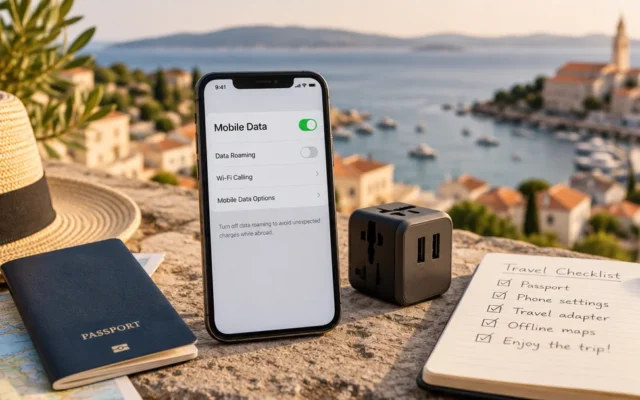
For your phone, compare an eSIM, a local SIM, and your carrier’s roaming plan. Whichever you pick, download offline maps, translation data, your tickets, and the address of your first hotel before you lose Wi-Fi. The offline map alone will rescue you more times than you expect.
Make an arrival-day plan
The most stressful part of any first trip is the first two hours on the ground, so decide in advance how you will get from the airport to your hotel. Carry the hotel’s address in the local language, use official taxi queues or marked transit rather than a stranger offering a ride, and let your lodging know if a delay will push you past reception hours.
Avoid booking a prepaid tour or tight activity for the moment you land. Give yourself room to be tired. Put your most important activity in the middle of the trip so a delayed arrival does not wreck it.
Keep a small offline folder
Before you go, put together a simple set of documents you can reach without an internet connection: a photo of your passport’s ID page, your insurance policy number and emergency line, your flight and hotel confirmations, your prescriptions with the generic drug names, and contact details for your lodging, your bank, and the nearest consulate. Give a trusted person at home a copy of your itinerary too.
One last check before you fly
A week out, recheck the government travel advice for your destination, the weather, and any strikes or closures, and confirm every reservation. Download what you need offline. Then leave yourself enough open time to actually enjoy being somewhere new, because the best first trip is not the one with the most stops. It is the one where you felt prepared enough to relax.