How to Do a Weekly Review That Actually Sticks (A 30-Minute System)
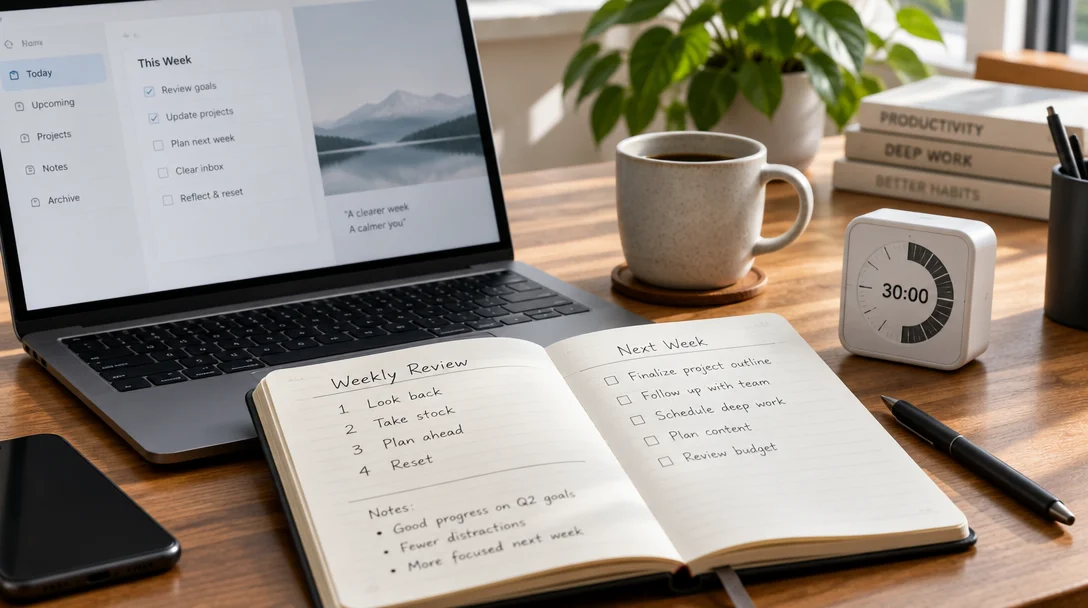
A weekly review is a 30-to-45-minute ritual of clearing inboxes, updating lists, and picking three priorities, so your system stays current and you stop keeping everything in your head.
Quick Answer
A weekly review is a short planning ritual, usually 30 to 45 minutes, where you clear your inboxes, update your task list, and decide what actually matters for the week ahead. The payoff isn’t a prettier to-do list; it’s a quieter head and a week where you react less and choose more.
Why your system keeps falling apart
Most people don’t fail at productivity because they’re lazy. They fail because their lists quietly go stale. Tasks pile up, priorities shift, and within a few weeks the gap between what your app says and what’s actually true has grown so wide that you stop trusting it. When you stop trusting your system, you go back to keeping everything in your head, and your head is a terrible filing cabinet.
Productivity author David Allen, who created the Getting Things Done method, calls the weekly review the “critical success factor” of any system. His point is simple: no system survives contact with a busy week. The review is what closes the gap, resets your lists, and lets you trust them again.
The three jobs a good review does
A useful weekly review does exactly three things. Keep all three in mind and it’s hard to go wrong.
- Get clear. Process every loose end, from your email inbox to the sticky note on your monitor. Each item gets a quick decision: delete it, file it, do it, or turn it into a task with a clear next step.
- Get current. Update your project and task lists so they reflect what’s true right now, not what was true three weeks ago.
- Get creative. Step back and notice patterns. What worked? What kept getting pushed? What should you do differently next week?
The 30-minute version, step by step
You don’t need a 11-step ceremony. A lean version gets most of the benefit.
1. Empty your inboxes (about 10 minutes)
Go through everything that collects “stuff”: email, your notes app, browser tabs, voicemail, the physical pile on your desk. For each item, make one of four calls: delete it, file it, do it now if it takes under two minutes, or turn it into a task. The goal is simple: zero undecided items.
2. Review your lists (about 10 minutes)
Look at your next actions and mark off what’s done. Then scan your calendar, both last week and the coming one, so you catch deadlines before they ambush you. Finally, check your bigger projects: does each one have a next step, or is it sitting there waiting to be forgotten?
3. Pick your priorities (about 10 minutes)
This is the part most people skip. Choose three things that genuinely matter for next week, and make sure each one has time on your calendar. A priority without a time slot is just a wish.
Make it a habit, not a chore
The review only works if it happens regularly, so lower the friction.
- Schedule it. Put a recurring 45-minute block on your calendar, ideally Friday afternoon or Sunday evening. Don’t leave it to chance.
- Start short. If 45 minutes feels like a lot, do 20. A short review done every week beats a perfect one you never do.
- Keep a fixed list of prompts. “What did I finish? What’s still open? What matters next week?” Repeat the same questions every time so you never stare at a blank page.
- Choose your tool and stop switching. A notes app, a notebook, or your task manager all work. What matters is that it’s the same place every week.
What to do when you skip a week
You will skip weeks. When it happens, don’t throw the whole habit away. Just do a longer catch-up review next time, or pick the single most important thing you lost track of and rebuild from there. The point of the ritual is resilience, not perfection.
The weekly review isn’t really about productivity. It’s about closing the loop so you can rest without the nagging feeling that you’ve forgotten something important. Spend one hour on it and you get back a calmer week, plus the one thing no app can give you: trust in your own system.