How to Pack a Week in a Carry-On: A Beginner’s Guide
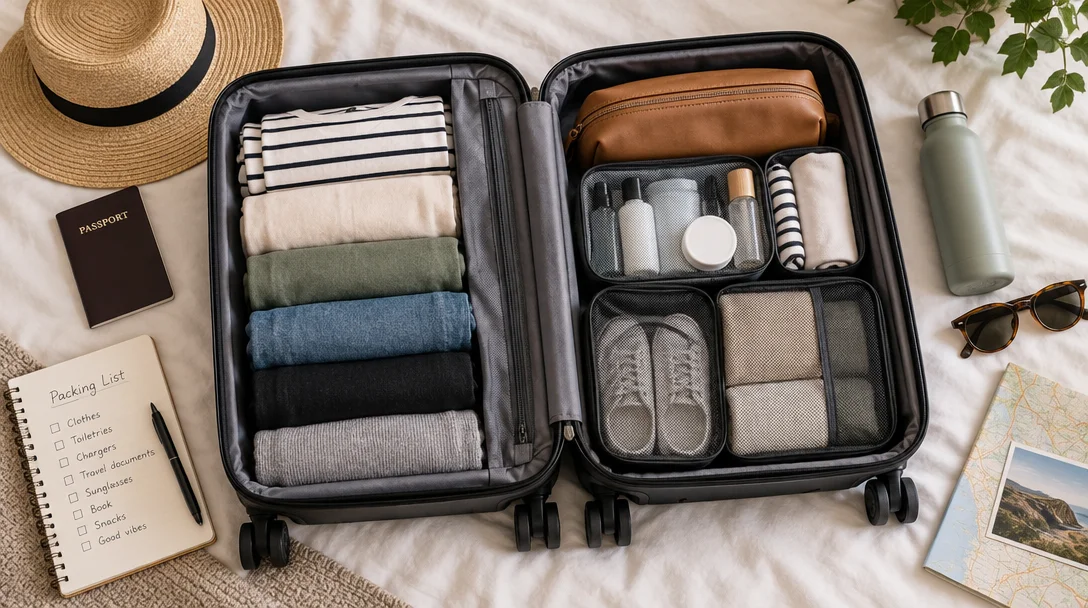
For a 7-day trip, pack about 5 tops, 2–3 bottoms, 2 layers, 5–7 sets of underwear and socks, and 2 pairs of shoes — wearing the bulkier pair on the plane. Choose mix-and-match neutral colors, roll your clothes, keep liquids under 100ml, and the whole week fits in a standard carry-on.
Yes, you really can fit a week of travel into one carry-on — and it is genuinely better: no checked-bag fees, no waiting at baggage claim, and no risk of lost luggage on tight connections. The trick is not packing less; it is packing to a system. This guide gives you that system, step by step.
Quick Answer
For a 7-day trip, pack about 5 tops, 2–3 bottoms, 2 layers, 5–7 sets of underwear and socks, and 2 pairs of shoes — wearing the bulkier pair on the plane. Choose mix-and-match neutral colors, roll your clothes, keep liquids under 100ml, and the whole week fits in a standard carry-on.
Start With the Right Bag
Most US airlines allow a carry-on up to 22 x 14 x 9 inches (56 x 36 x 23 cm), including wheels and handles. But limits vary: budget carriers are stricter — Ryanair’s free allowance is only a small under-seat bag (40 x 20 x 25 cm), and easyJet’s free bag is 45 x 36 x 20 cm. If your trip mixes airlines, pack for the strictest one on the itinerary.
For a week, target a 35–45L bag. A lightweight soft-sided bag or travel backpack squeezes into tight overhead bins more easily than a rigid hard-shell, and many international carriers also impose weight limits (typically 7–10 kg), so a bag that weighs 3 kg empty eats your allowance before you pack anything.
The Clothing Formula: 5-4-3-2-1
The single biggest mistake is packing seven complete outfits. Instead, pack pieces that combine:
- 5 tops — mostly neutral colors, at least one long-sleeve
- 4 pairs of underwear and socks — quick-dry fabrics let you sink-wash if needed
- 3 bottoms — e.g. two casual, one smarter pair
- 2 layers — a mid-layer like a fleece or knit, plus a packable jacket or rain shell
- 1 pair of shoes packed — and wear your bulkiest pair on the plane
Five tops times three bottoms gives you fifteen base combinations — more than a week of outfits from roughly fifteen items. Stick to 2–3 neutral base colors (black, navy, gray, olive) so every top works with every bottom.
Fabric Matters
Merino wool and quick-dry synthetics are the two fabrics that make carry-on-only travel easy. Both resist odor longer than cotton, pack smaller, and dry overnight when hand-washed. Cotton is the enemy of light packing: it is bulky, slow-drying, and holds odor.
How to Actually Pack the Bag
- Roll, don’t fold. Rolling t-shirts, underwear, and lightweight trousers saves 15–30% of space versus flat folding and cuts creasing. Store rolls vertically so you can see everything.
- Use packing cubes. One cube per category (tops, bottoms, underwear) keeps the bag organized and repackable. Compression cubes squeeze bulky items like fleeces by a further 30–50%.
- Shoes go at the perimeter. Bag them, stuff socks inside, and place them along the sides and base near the wheels.
- Heavy items low, delicates on top. Toiletry bag and electronics near the wheels; wrinkle-prone items on top where pressure is least.
- Wear your bulk on travel day. Heaviest shoes and biggest jacket on your body, not in the bag — this alone frees several pounds and litres.
Toiletries: Think Solid
The liquids rule is unchanged: containers of 100ml (3.4 oz) or less, all in one clear quart-sized bag, one bag per person. The smartest move is switching to solids — a shampoo bar, solid deodorant, and toothpaste tablets don’t count toward your liquid allowance at all and won’t leak. Unless you’re staying in hostels or rentals, hotels provide shampoo, conditioner, and body wash.
Tech: Keep It Minimal
Phone plus charger, a power bank (under 100Wh, and it must go in your carry-on — never checked), headphones, and one multi-port charger or a single USB-C cable replace a tangle of device-specific gear. A small cable pouch in your personal item keeps it all findable. If you bring a laptop, carry it in your personal item so it doesn’t eat clothing space.
The Laundry Unlock
If your trip stretches past a week, don’t pack more clothes — plan one laundry stop. A few detergent sheets (flat, weigh nothing, not a liquid) plus a universal sink plug let you hand-wash in any hotel sink: soak 15–20 minutes, rinse, roll in a towel to press out water, hang overnight. Quick-dry fabrics are dry by morning. One mid-trip wash effectively doubles your wardrobe — this is how people travel two weeks from the same bag.
What to Leave at Home
- “Just in case” outfits — if no specific day on your itinerary needs it, it stays home
- More than two pairs of shoes — shoes are the biggest space killer in any bag
- Full-size toiletries — buy consumables at the destination if you run out
- Books — your phone or e-reader weighs nothing
- Hairdryer — virtually every hotel provides one
The golden rule: if you are debating whether to bring something, you don’t need it. Anything you forget, you can buy.
When to Check a Bag Instead
Carry-on-only isn’t right for every trip. Winter trips of a week or more with a heavy coat and thermals, travel with sports gear (ski, dive, bike), family travel with young children, or a long-haul fare that already includes a checked bag — in these cases checking is the pragmatic choice, not a failure.
Packing Timeline
- 2 weeks out: check the forecast, check your airline’s carry-on rules, decide on a laundry strategy
- 1 week out: lay out every outfit combination; remove anything that doesn’t pair with at least two other pieces
- 2 days out: wash what you’re packing, pack fully, and weigh the bag
- 1 day out: check in online, download offline maps, lay out your travel outfit
- Travel day: wear the heaviest shoes and jacket, do a final document check
Bottom Line
A week in a carry-on comes down to three things: a capsule wardrobe in neutral colors that all mix, a packing method (rolling plus cubes), and wearing your bulk on the plane. Follow the 5-4-3-2-1 formula and you’ll walk past the baggage carousel every time.
Sources & Methodology
This guide synthesizes nine independent sources rather than paraphrasing any single one. Airline carry-on dimensions, weight limits, and personal item rules were checked against airline baggage pages and two multi-airline comparison tables (SmarterTravel and US News), with American Airlines’ own policy page used as the primary source for US carry-on and personal item sizes. The packing systems, clothing formulas, and fabric advice were cross-checked across six independent 2026 packing guides (Autopilot, National Traveller, TripGazer, mytrippack, luggagefortravel, organizing.tv); recommendations that appeared consistently across multiple sources — rolling, packing cubes, wearing bulk items on the plane, solid toiletries, mid-trip laundry — were kept, while claims appearing in only one source were treated cautiously. The TSA 3-1-1 liquids rule and the FAA requirement that power banks travel in carry-on were confirmed against official TSA and FAA guidance as reported in these sources. No products were personally tested for this article; it is a research synthesis, not hands-on review.