Small Business Marketing on a Tight Budget: Where to Start (and What to Skip)
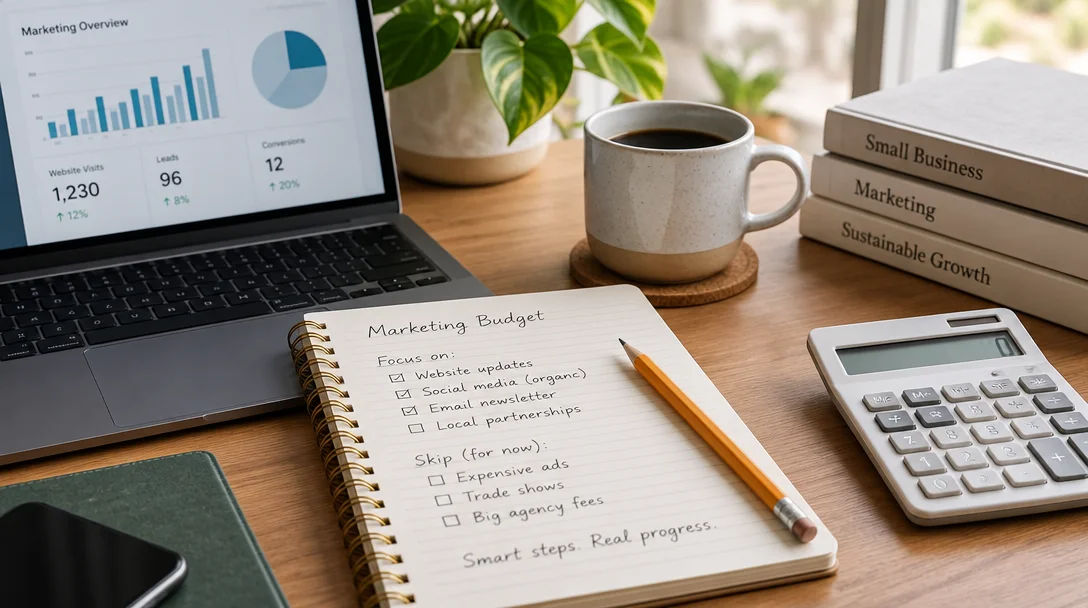
Claim your Google Business Profile, start collecting customer emails, and ask happy customers for reviews and referrals. Email typically returns around $36 per $1 spent, the best value in small business marketing. Skip paid ads, rebrands, and extra platforms until the free basics are running.
Most small business marketing advice fails for one simple reason: it assumes you have money, time, or a marketing team. You probably have none of the three. You have a business to run, and marketing is the thing you squeeze in at 9 p.m. after the invoicing is done.
So let’s skip the theory. Here is the shortest sane path from “nobody knows I exist” to “customers keep finding me,” built around things that cost little or nothing.
Quick Answer
Start with three free moves: claim and fill out your Google Business Profile, set up a simple way to collect customer email addresses, and ask happy customers for referrals and reviews. Email is consistently the highest-return channel for small businesses, often cited at around $36 back for every $1 spent. Everything else (ads, influencer campaigns, a rebrand) can wait.
Step 1: Claim your Google Business Profile (free, one afternoon)
If you serve local customers, this is the single highest-value hour you can spend. Your Google Business Profile is the box that shows up when someone searches “bakery near me” or “plumber in Dayton.” Claiming it is free, and you control the photos, hours, services, and replies to reviews.
An unclaimed profile often has wrong hours, no photos, and unanswered bad reviews. That quietly costs you customers who never even reach your website.
Go to business.google.com, search for your business, claim the listing (Google will verify by mail, phone, or email), then fill in everything: accurate hours, real photos of your work or storefront, your services, and a short description written like a human. Post an update once a month or so. Done.
Step 2: Start collecting email addresses from day one
Email sounds old-fashioned next to TikTok, which is exactly why it works. It’s the only channel you actually own. No algorithm decides who sees your message, and no platform can shadow-ban your customer list.
The numbers back this up. Studies from Litmus and the Data & Marketing Association put average email marketing returns at roughly $36 for every dollar spent, which is higher than most other channels. Your mileage will vary, but the direction is consistent: email is cheap to send and lands in front of people who already chose to hear from you.
How to start without fancy software:
- Ask for email addresses at checkout, in person, or in your invoice footer, with permission to send occasional updates.
- Give people a reason to sign up: a small discount, early access, or genuinely useful tips related to what you sell.
- Send something short and real once or twice a month. A note about a seasonal offer, a new service, or a customer story beats a polished newsletter nobody reads.
Free tiers on mainstream email platforms cover small lists, so cost is not an excuse to wait.
Step 3: Get intentional about referrals and reviews
Happy customers are your cheapest marketing channel, and most small businesses leave them completely untapped. People rarely leave a review unprompted, but they very often will if you simply ask at the right moment, which is right after you’ve delivered something they’re pleased with.
Pick a system, any system: a follow-up text with a review link, a card in the bag, a line in your invoice email. Then do the same for referrals. A straightforward approach that works for many small businesses is offering a small thank-you (discount, add-on, gift card) when an existing customer sends you a new one.
When reviews arrive, respond to them, including the cranky ones. A calm, helpful reply to a bad review often says more to future customers than ten five-star ratings.
Step 4: Pick one social platform and ignore the rest
You do not need to be everywhere. You need to be where your customers actually spend time, consistently enough to be remembered.
Choose based on what you sell:
- Visual products (food, flowers, furniture, tattoos): Instagram or TikTok.
- Local services: Facebook still carries a lot of weight, especially with an older customer base.
- Other businesses as clients: LinkedIn.
Post when you have something real to show: finished work, behind-the-scenes, a question for customers. Three honest posts a week on one platform beats a ghost town on four. Delete the guilt about the platforms you’re ignoring. That’s strategy, not failure.
Step 5: Try a small paid test only after the free stuff is running
Paid ads can work, but they’re a multiplier on a working funnel, not a substitute for one. If your profile, reviews, and follow-up are a mess, ads just send strangers into a leaky bucket.
When you do try, keep it genuinely small. The U.S. Small Business Administration’s local marketing guidance suggests starting with a modest test budget (their example is around $100) and treating the first campaign as an experiment, not a bet. Spend it where intent is highest (search ads for people already looking for your service) rather than on broad awareness blasts.
If it works, scale slowly. If it doesn’t, you learned that for the price of a nice dinner.
What you can safely skip for now
Every hour is scarce, so here’s permission to not do things:
- A logo redesign or rebrand. Nobody avoids a business because of its 2019 font.
- Being on every platform. See above.
- Influencer campaigns. Great for some product brands, usually premature for a business still finding its first hundred customers.
- Brochures, QR-code merch, sponsored events. Unless your customers specifically live there.
A simple 30-day plan
Week 1: Claim and complete your Google Business Profile. Week 2: Set up review and referral asks. Week 3: Start collecting emails and send your first message. Week 4: Pick your one social platform and post three times.
That’s it. No agency, no ad budget, no marketing degree. Most of this is free, all of it compounds, and unlike most business advice, you can start tonight.
Sources & Methodology
We used guidance from the U.S. Small Business Administration on local marketing and small-budget tactics (including their suggested ~$100 starter ad test), Google’s own Business Profile documentation, and widely cited email ROI research from Litmus and the Data & Marketing Association (approximately $36 return per $1 spent, averaged across industries). Statistics are averages and individual results vary.